The What and the How
I recently watched a video about abstract photography, and how it can help
to engage with the fundamentals of composition and form. Photography is a medium that can get really
bogged down in technicalities, to the point of becoming more utility than expression. Of course, it all
depends on application. If the aim is to record, document, and reproduce, then aspects like resolution,
sharpness, distortion, and color accuracy are major priorities. In artistic pursuits, though, getting
caught up in hardware specs can turn into a distraction and hinder the creative process.
I'm not an expert in compositional rules and theory, so I won't try to
flounder around explaining those things here. However, I will state that even if you're focus is
reportage and documentary work, it is extremely important to have a grasp of the foundations of artistic
composition (something my highschool photojournalism teacher actually disagreed with!
She argued that art had no place in journalism... I don't think she was a good teacher or photographer).
How you frame a subject can have a massive impact on what the viewer focuses on and even how the subject
is judged. Just take a look at
Christopher Anderson's Vanity Fair photoshoot of Republican cabinet members to see this principle in
action. It isn't just about what is being shown, but also how.
Subject Matter
In the service of honing focus on composition, choosing subjects that are
not readily discernable can actually be helpful. Concentrate on textures and shapes. High contrast
lighting with sharp, well defined highlights and shadows can help simplify. Rather than trying to photograph
a specific object, such as a person or a building, aim to photograph forms, shapes, and their arrangement.
Being able to define the actual thing being photographed is not the priority, and it's ok for it to be unrecognizable; just
try to work on interesting shapes, textures, and placement. See that what is in the frame is not any more
important than how it is framed.
I'm not saying this is always how one should take pictures, just that changing
what is prioritized can be a greatly rewarding exercise. But if this is the type of
photography you want to concentrate on, I enthusiastically encourage it! Starting out, learning how to
shoot, develop, and print, my foremost inspiration was
Man Ray, learning how to make photograms and solarized prints in the darkroom myself (I'm probably
part of the very last generation of students to primarily learn on analog equipment... kind of weird to
think about).
Aquatic Exercises
This particular blog post is more than discussion; it is a recommendation. I am
imploring you to go take photos at an aquarium with some very specific constraints. Aquariums typically
do not allow flash, and the tanks are often set up with exotic lighting. Being a film photographer, I
don't shoot over ISO 1600 very often, and even 6400 is considered pretty extreme, so such a setting is
less than ideal for getting conventional pictures. Though of course, limitations can lead to creative
results.
I brought along a few rolls of Tri-X pushed to 1600 and a 50 f/1.4 lens. Shallow
depth of field, high contrast, and prominent grain is the order of the day with this setup. If you're
shooting on digital, just set your ISO to 1600 or 3200 (and don't change it), use a high
contrast black and white profile when editing, and don't correct for underexposure too much. You will
absolutely miss some shots like this. Some subjects will be moving too fast or not be lit well
enough, but the point is to get unique results, so stick to it! Even better if you commit to manual
focus only; slow yourself down and hamper your camera's capabilities.
Most of the time, I didn't even bother to meter, setting my shutter speed to
1/60 or 1/30 (trying to be as still as possible) and aperture lower than f/2.8, I took these shots
and just hoped something would come out. Film doesn't handle low light as well as digital, so a lot of
shadow detail just gets lost. Again, I'm not in it for technical perfection here, so that's ok, and
this attribute actually contributes to the look I'm going for. I want to see odd creatures set in
an almost otherworldly scene.
Results and Lessons
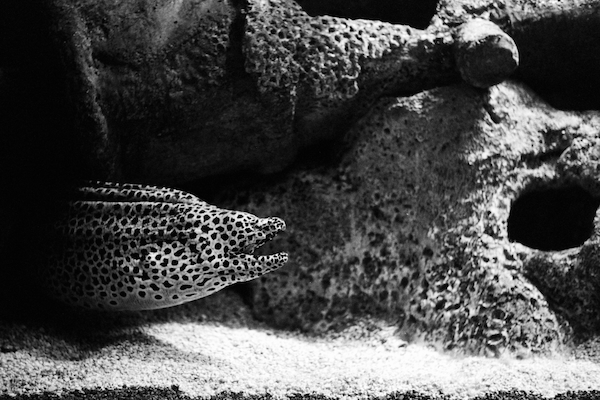
So how did I do? This isn't supposed to be an evaluation of the resulting photos, but rather of the resulting lessons learned. I found the limits frustrating at times, but I really enjoyed the experience of letting go of considerations for exposure and lighting. I just shot, trying my hardest to make sure what little I assumed would show up on the film was at least an interesting shape. Let's take a look:




Doing it Again
Taking black and white pictures at the aquarium was really nostalgic for me, as
it was one of the very first places I shot when I took my first photography class at 16! Back then, I
was using my grandmother's long neglected Konica Autoreflex T2, loaded with Ilford HP5. I remember
making an 8x10 print of a lionfish on Ilford paper (pretty sure the class was all using Ilford chemistry
too). Sadly, all my early film and prints were stored in a non-climate-controlled place, got moldy, and
had to be thrown out (don't let your parents hold onto your entire body of work while you're away at
university). I've been pretty good about archiving, both physically and digitally, since then.
Going back to the aquarium, I'd probably bring an autofocus body, and I'd
probably load it with P3200 to give myself an extra stop of exposure. Though in truth, I think the technical
limitations and uncertainty are what made these photos so interesting to me, and I have to wonder if
giving myself such advantages would actually end up making for less satisfactory pictures and a less
engaging experience. Of course, there's only one way to find out, and I urge you to do the same!
← back